I closed the tab and leaned back in my chair, glad to be away from the chaos that data hiring has become. I’d already deleted my account from their system, but staring at the blank screen, I realized that clicking “delete” only gave the illusion of a clean break. You can refuse to hand your passport over to them, but you can’t uninstall what they’ve left in your head.
Out of curiosity, I started watching how other independent contractors were dealing with these automated filters. I found a whole world of forum posts, YouTube tutorials, and community strategy guides — all coaching candidates to reshape not just what they said, but how they structured their thoughts in real time so an algorithm would approve of them. One tutorial instructed candidates to answer like a checklist: identify the problem, verify the data, derive the solution, document it. The format itself would keep the machine from flagging them for pausing too long. But nobody was teaching people how to beat the system or how to push back against it. They were teaching them how to get past the gate.
People practiced speaking without hesitation, flattening their speech into predictable, uniform chunks. They changed how they talked so the automated interviewer’s blue circle wouldn’t flash red. They were automating themselves from the inside out, sanding down their voices and rhythms just to get a shot at being evaluated by a person. The tutorials were thorough, and a little sad to see.
A few days later, a transcription file landed on my desk that the automated tools had completely botched. It was a bilingual recording where one of the speakers spoke English with a heavy accent and switched freely into Spanish mid-sentence. She clearly hadn’t watched any of those tutorials, and she wasn’t trying to adapt to the machine. Her speech wasn’t disorganized. The chaos appeared only after the software tried to compress it into text.
The job required me to highlight or italicize only the English terms, which turned out to be a logistical nightmare for any AI tool, since the Spanish words were mixed directly into English sentences with no clear boundary. The recording itself wasn’t the problem. The commercial transcription tools I use only handle one language at a time. They can’t process the audio of someone whose mind naturally moves between two languages.
Once I had a working transcript and needed to format it, every AI tool I tried ran into trouble. One just started wrapping everything in asterisks, trying to brute-force a fix. Another gave me a long explanation about why the task was too complicated to do safely. A third gave it a real shot but left me with a garbled mess I had to clean up anyway. These models can process people who’ve already flattened themselves for the scanner, but they fall apart the second they run into someone who actually talks the way people talk.
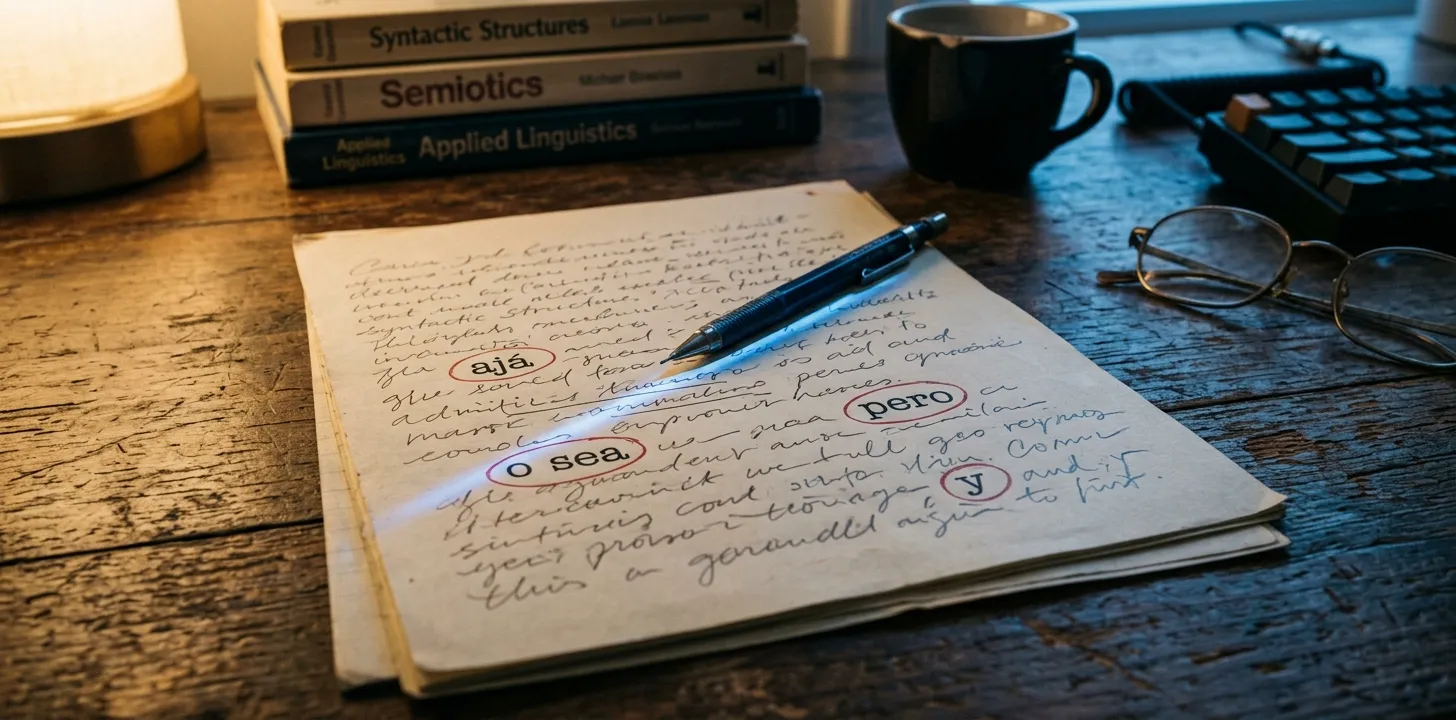
The software turned out to be useless to me. To get the job done, I had to devise my own workaround. Since English was the dominant language in the audio, I italicized the whole document and set the language to English. Then I used Word’s basic spell-checker to catch the Spanish words, flagging them in red. That was exactly what I needed. After that, it was just a manual find-and-replace pass to catch the small stuff the spell-checker wouldn’t flag: the “ajá,” the “o sea,” the “pero,” and the “y” mixed into otherwise English sentences.
Those small words matter. In a real transcript, even a pause or a false start can carry meaning.
Those are the kinds of words that the “get past the gate” tutorials tell people to cut from their speech. To a machine, they’re nothing but noise. To an actual person, they’re a normal part of how people talk, especially when they’re moving between two languages and two cultures.
I finished the job and delivered solid work on time. It felt good to hand over something done properly, the old-fashioned way.
I only got the chance to prove my skills here because I happened to get a speaker who’d never make herself “readable” to the machine. We’re being pushed to sand down the parts of ourselves that don’t fit a system, and then treat that flattening as a sign of competence. The stuff that gets flagged as an error is usually the most human part of what we’re doing.
Nothing dramatic happened after this. There was no grand manifesto, no sweeping exit from the digital world. Instead, I did what freelancers have always done: tallied up the word count, sent the invoice, and got back to work.
The automated hiring platforms are still out there, scanning faces and flattening voices. But my desk remains independent territory.
I choose to stay a blur.
Technology is the setting. Humanity is the subject.