What Readers Actually Want From Writing
I started thinking about this after reading a recent piece from Medium, “Write for humans, not algorithms,” by Zulie @ Medium. I agreed with much of her argument, particularly the idea that when readers ask whether something was written by AI, they may really be asking whether they can trust it. But it left me with another question: what happens before trust?
What if you could know, with absolute certainty, whether a piece of writing had been generated by AI?
It’s an appealing thought. For platforms and readers drowning in a sea of synthetic prose, a perfect machine detector sounds like the ultimate filter. But once you start tugging on that thread, the premise begins to unravel. The standard logic goes like this: we need to spot AI text so we can figure out whether to trust it. For some readers, knowing whether a piece was generated by AI has become a shortcut for deciding whether it’s worth trusting. It sounds intuitive. But it rests on a fundamentally flawed idea of how people actually read.
By framing the AI debate almost entirely around “trust,” we are missing the real question: What are readers actually looking for when they give a piece of writing their time?
But there’s a bigger problem with the way we’re framing digital publishing right now. We’re treating trust as something readers bring to the page before they start reading — a prerequisite for opening an essay — rather than something a writer earns by the time they reach the final line.
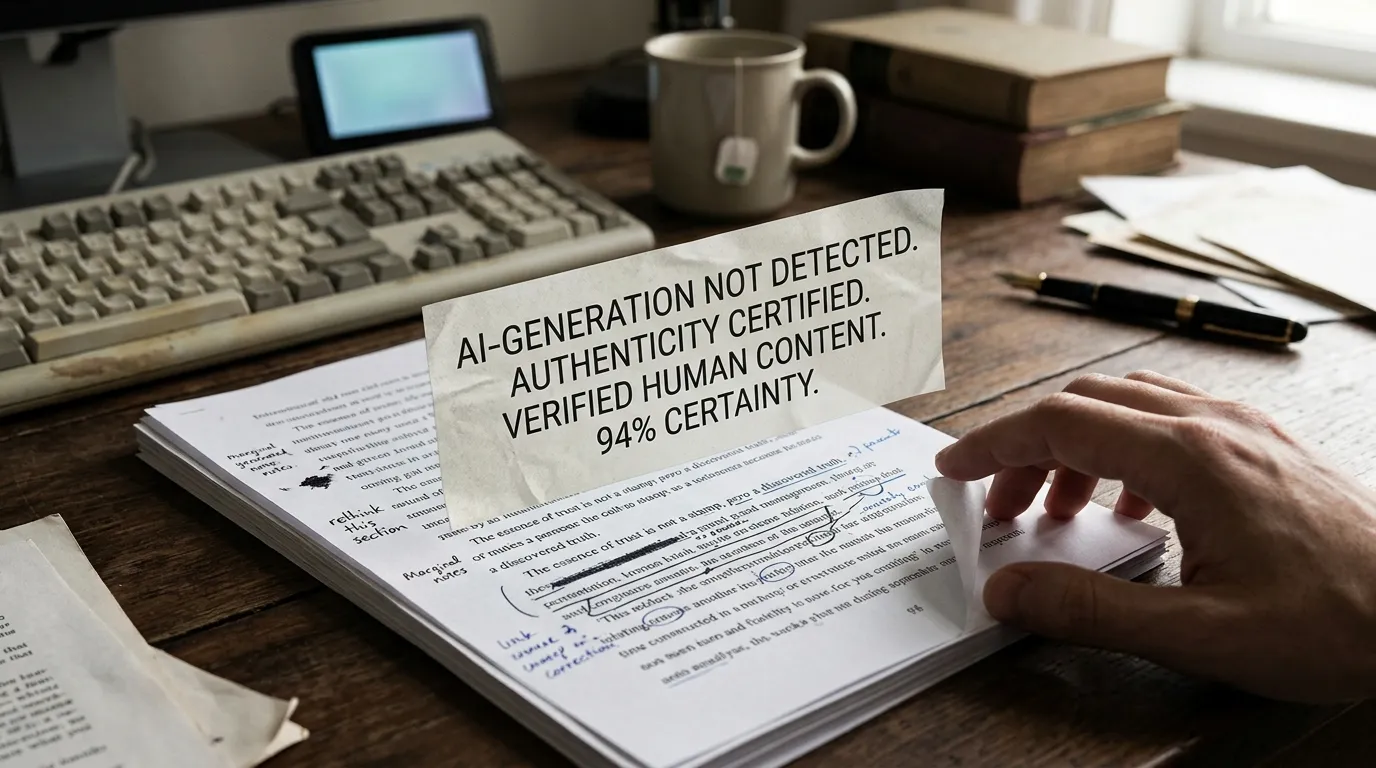
The impulse to build automated filters makes sense. We’re swimming in conversational models capable of producing enormous amounts of smooth, frictionless, often hollow text. Naturally, platforms want to reassure readers by adding guardrails or stamping pieces with a “100% Human” label.
The problem? An AI detector measures syntax, not integrity. A piece of writing can be typed by a real human sitting at a real desk and still be lazy, wildly inaccurate, or plain manipulative. On the flip side, a thoughtful writer might use an AI tool to translate a quote, polish a rough draft, or format research without losing an ounce of the story’s core honesty.
When you strip away the tech jargon, for many readers, that concern ultimately comes down to whether a real human stands behind what is being said. Responsible writing involves work that happens long before the sentences appear: choosing a subject, wrestling with real experiences, checking facts, deciding what to leave out, and taking responsibility for what you’ve put in front of the reader. That responsibility is what gives writing its integrity. The real line facing publishing today may not be AI versus human. It may be careless output versus responsible creation.
Even if we agree that responsible creation matters more than the tool used, a bigger issue sits right in front of us. Almost every discussion about digital publishing assumes that readers only engage with authors through established relationships. We’re told over and over that readers need to trust the writer, trust the process, and trust the platform. Except that model falls apart the moment you discover someone new.
Call it the First-Piece Problem. Imagine you’re scrolling through your feed and land on a brilliant, moving essay by someone whose name you’ve never seen in your life. No follower count, no blue checkmark, no archive of work you recognize. They might never write another article again. You know zero about their background or their credentials.
Do you trust them? Not yet. You don’t know them.
And yet, you click. You read to the end and think, I’m glad I spent ten minutes on that.
Notice what happened? Trust wasn’t part of the transaction. You didn’t read the essay because you trusted the author; you read it because something about the piece earned your attention — a sharp headline, an intriguing hook, or a subject you cared about. The essay simply paid off that attention with value.
The unknown writer isn’t an edge case — they are the very definition of discovery. If publishing platforms only recommend writers we already trust, they aren’t recommending anything at all. They’re just reinforcing existing reputations.
Readers don’t owe a new writer their trust. A new writer can’t earn trust before you’ve read them; they can only earn your attention.
Trust isn’t always the price of admission. Often, it’s a downstream outcome of having found value in someone’s work.
There are writers whose work we know before we know anything about them. There are writers who publish one extraordinary essay and disappear. There are anonymous writers whose names mean nothing to us but whose sentences stay with us for years. We don’t need to trust these people first. We need a reason to keep reading.
That is a completely different relationship. We aren’t saying, I believe this person because I know who they are. We’re saying, This person has given me something worth thinking about.
When we evaluate a text, we’re actually making three different judgments: Can I trust the writer? Can I trust the claims? And was this worth my time?
Those questions overlap, but they aren’t the same. A reader can distrust the claims, distrust the author, and still value the experience. You can read a deeply flawed opinion piece, disagree with every assertion in it, and still be glad you read it because it forced you to sharpen your own thinking. You can trust a favorite journalist implicitly and still find their latest column dull. And most importantly, you can find enormous value in an essay written by a complete stranger without knowing enough about them to grant them your confidence.
This flips the whole debate on its head. Instead of asking how platforms can flag synthetic text to preserve trust, the better question is: How do we help people encounter writing that is actually worth their time?
When we reduce the AI conversation to a game of detection, we turn reading into a tedious audit. We force readers to act like forensic investigators — hunting for weird phrasing or mechanical rhythms — instead of letting them engage with the ideas on the page. A piece of writing doesn’t work because it passed a software check. It works because it gives us something — a compelling idea, a distinct point of view, a new way of seeing something, a story worth following. If a piece is boring or soulless, it fails the reader whether it was generated by ChatGPT or typed out by hand.
The job of a platform isn’t to guarantee that every writer is trustworthy before we meet them. It’s to help us meet writers worth reading. What happens after that — whether we return, follow, recommend, or eventually trust them — gets built over time, one piece at a time.
Author’s note: Did knowing how this essay was constructed change whether the ten minutes you spent reading it felt worthwhile?
Disclosure: This essay was built using a human-directed argument and structural outline, drafted with AI assistance, and editorially revised and polished by the author.
Technology is the setting. Humanity is the subject.